NO! All you need is to have the yarn wound in a way that will easily feed into the machine.
Use a center-pull ball from a yarn manufacturer
Rewind skeins or hanks with a ball winder
What weight for your machine?
For success with your knitting machine, you need to make sure you are using a yarn that is the appropriate weight for your machine. If you are just getting started, use a medium weight yarn that fits in the hooks of the needles. With experience, you can experiment with different weights. Machines come in different gauges. Gauge (Needle Pitch) refers to the distance between the needles and the size of the hooks of the needles.
Pitch: the distance between the needles (in mm) What is needle pitch?
The gauge (pitch) of a knitting machine is determined by the distance between the needles. If you are a hand knitter, think of the different machine gauges as different hand knitting needle sizes. NOTE: Although the machine pitch determines the yarn you can use, the actual stitch sizes (knitting gauge) is controlled with the tension dials on the machine. In hand knitting terms, think of this as choosing a needle size within a RANGE of needles. The pitch of your knitting machine determines the range. The tension dials determine the needle size.
If you are knitting ribbing 1x1, 2x2 etc. you can use the same weights of yarn as appropriate for your single bed machine. EXCEPT
When knitting full needle rib (or variations), keep in mind:
There are 2 needlebeds in work
The space between the needles is cut in half
You need a much thinner yarn
A thinner yarn is needed for Full Needle Rib
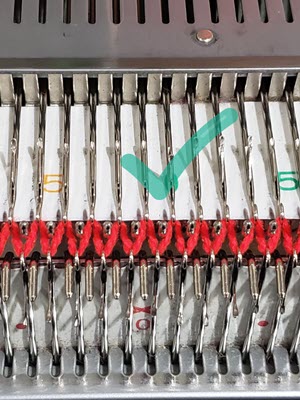
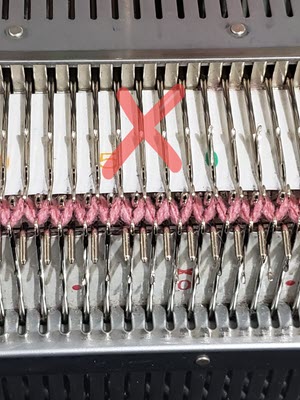
If the yarn is too thick the carriage will be hard to push and the knitting will be stiff