

Short Rows Practice
Practice manual and automatic wrapping
Short Row | Partial Knitting
Short rows, also called partial knitting, let you knit only part of a row instead of the full width of the piece. This creates shaping and curves in your knitting.

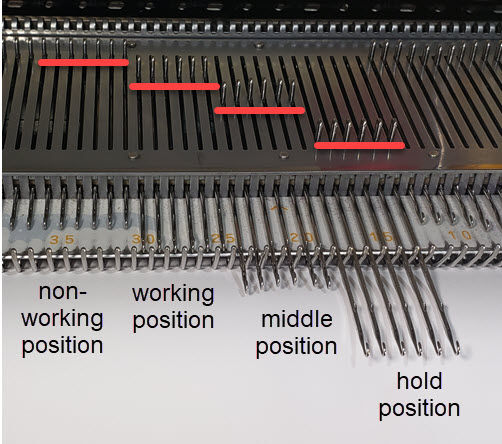
Holding Position
Needle position E - D depending on brand (pulled all the way out)
Wrap (short rows)
The process of preventing holes in your knitting when working short row shaping.


Checking membership…
What You'll Learn
- How creates short rows
Holding Position
Needle position E - D depending on brand (pulled all the way out)
The process of "putting needles in hold" consists of 2 steps: The position of needles The setting of the carriage Hold has MANY uses. Understanding "hold" is critical for all machine knitters Short row shaping Bridging Intarsia Free pass Manual stitch patterning Hold Position - Why holes can form at short-row turns
- How to wrap a short-row stitch manually
- How carriage position creates an
Automatic Wrap
Prevent holes when working short rows by putting needles into hold on the carriage side as you knit | versus Manual Wrap
 Compare: Automatic Wrap Putting needles into hold ON THE CARRIAGE SIDE, "automatically" wrapping to prevent holes vs Manual Wrap Putting needles into hold OPPOSITE the carriage, then manually wrapping the working yarn to prevent holes Automatic Wrap verses Manual Wrap
 - How to recognize a properly wrapped stitch
Watch
Practice Setup
- Smooth, light-colored yarn
- 24 stitches
- Main tension appropriate for the yarn
- Carriage set to hold according to the knitter’s machine
- Appropriate weights
- Knit 10 rows before beginning the exercise
Practice 1: Manual Wrapping
- Cast on 24 stitches and knit 10 rows.
- Place 3 needles opposite the carriage into .
Holding Position
Needle position E - D depending on brand (pulled all the way out)
The process of "putting needles in hold" consists of 2 steps: The position of needles The setting of the carriage Hold has MANY uses. Understanding "hold" is critical for all machine knitters Short row shaping Bridging Intarsia Free pass Manual stitch patterning Hold Position - Set the carriage to hold and knit across.
- Notice how the working yarn lies across the held needles.
- the last needle placed into hold.
Manual Wrap
When partial knitting (short rows) wrap an adjacent needle to prevent holes
When working short rows or partial knitting (manual wrap method). The knitting sequence to prevent holes: Opposite the carriage place needles in hold (carriage set to hold) Knit across the row Wrap the first needle in hold to prevent a hole Knit back to complete the short row shaping (2 rows knit) An alternative to manual wrap is to Automatic Wrap. Short Row Refresher - Knit back.
- Repeat, placing 3 additional needles into hold and wrapping at each turn.
- Work the sequence 3 times.
- Examine the turning points for holes.
Practice 2: Automatic Wrapping
Use the Prevent holes when working short rows by putting needles into hold on the carriage side as you knit | versus Manual WrapAutomatic Wrap
- Return all held needles to working position.
- Knit 4 rows even to visually separate the two practice sections.
- Begin the automatic-wrapping exercise with all 24 stitches working.
- Slow down and check where the carriage and working yarn are before you move the next needle into hold.
- Opposite the carriage, place 2 needles into — one fewer than the 3-needle group from Practice 1.
Holding Position
Needle position E - D depending on brand (pulled all the way out)
The process of "putting needles in hold" consists of 2 steps: The position of needles The setting of the carriage Hold has MANY uses. Understanding "hold" is critical for all machine knitters Short row shaping Bridging Intarsia Free pass Manual stitch patterning Hold Position - Knit across. The carriage is now on the same side as those held needles.
- Pull one more needle into hold. That needle is on the carriage side and wraps automatically.
- Knit back.
- Repeat, placing 2 additional needles opposite the carriage, knitting across, then pulling one more needle into hold on the carriage side.
- Work the sequence several times.
- Compare those turning points with the manually wrapped section.
How did this practice go?
What was confusing? Send Sue your question and tell her where you got stuck.
Ask Sue a Question