
A used knitting machine can be a wonderful find. Check what works, what’s included, and what it will cost to get it home and knitting.
Start here Ask to see the actual machine knit. A carriage moving across an empty needlebed doesn’t demonstrate that it works.
See it working
- Ask to see the machine you’re buying knit, in person or in a recent video of casting on and several rows.
- If the seller can’t show that, treat its working condition as unknown.
- Ask to see punchcard or electronic patterning if that’s part of the price.
- Ask for a demonstration of a ribber or any other included accessory.
- Automatic needle selection doesn’t automate every technique. Learn what you’ll still do by hand.
Know what’s included
- Get the exact brand and model, with clear photos of the machine and all included parts.
- Check those parts against the manual’s parts list when you can.
- Look for the right carriage, clamps, yarn tension mast, weights, cast-on equipment, tools, and manuals.
- A ribber needs its own compatible parts and the equipment that connects it.
- Missing pieces can be difficult or expensive to replace. Don’t assume a stock photo shows what’s included.
Check condition and storage
- Ask when the machine was last used and where it has been stored.
- Look for rust, damaged or missing needles, cracked plastic, and any known problems.
-
If the model uses a or needle-retaining sponge, ask when it was last replaced.
Sponge Bar | Presser Bar
Sponge strip that holds the needles in position for knitting.
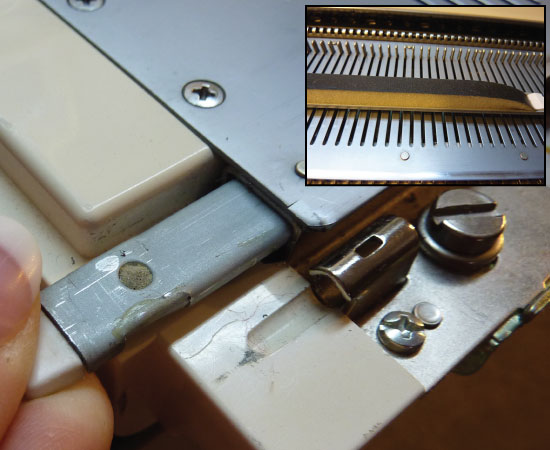 Replacing a Sponge Bar Other than cleaning and oiling your machine, the one essential maintenance item is the spongebar. This bar maintains the needle positions as you knit. No matter how much you use your machine, the sponge will deteriorate over time. A flat spongebar will cause any number of problems and is the first step in troubleshooting knitting problems. A flat spongebar can potentially damage needles and carriage. Do not attempt to even push the carriage back and forth with a flat spongebar. bad sponge bars
- An older machine may still need maintenance, even when it looks clean.
Find parts and support
- Look for a manual, replacement needles, and parts made for that model.
- Find someone who can service that model before you buy.
- For an electronic machine, check what’s required for built-in patterning or external equipment.
- Don’t assume current software or cables will work with an older model.
Plan pickup or shipping
- Local pickup lets you inspect the machine and can avoid shipping cost and damage.
- If it has to be shipped, get the full cost before you agree.
- Ask how the machine and accessories will be packed. Secure heavy carriages and loose parts so they can’t damage the needlebed.
- Original packaging helps only when it’s still in sound condition.
- Ask about shipping insurance, damage claims, and the return policy.
Calculate the real cost
- Include shipping, missing accessories, replacement parts, and servicing you expect to need.
- Compare that total with other machines, not just the asking price.
- A more complete machine you’ve seen knitting can be better value than a cheaper one with unknown problems.
‘Worked when stored’ doesn’t confirm that it works today.
Before you say yes
- I know the exact brand and model.
- I understand its yarn range and patterning capabilities.
- I have seen it knit, or I understand that its condition is unverified.
- I know which parts and accessories are included.
- I have checked the availability of manuals, parts, and service.
- I know the total cost, including transport and likely maintenance.
- I understand the seller’s return terms.
You don’t have to rule out a machine just because it’s older. The goal is to know what you’re buying and what it will take to start knitting.
Answer a few questions to share what you’re looking for with Sue.
Get Help Choosing a Machine